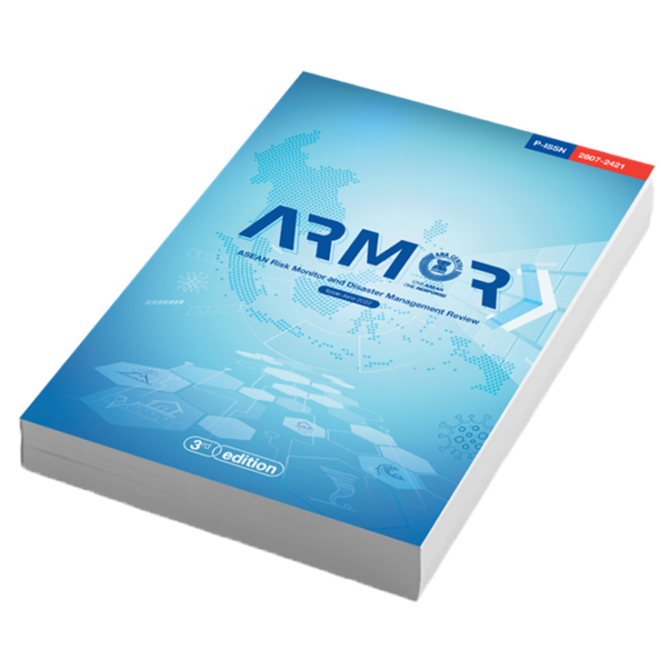
ARMOR 3rd Edition - When Disasters and Pandemic Collide: What does it mean to ASEAN, now and into the future?
Description
Abstract
With the publication of the third edition of the ASEAN Risk Monitor and Disaster Management Review (ARMOR) – titled When Disasters and Pandemic Collide: What does it mean to ASEAN, now and into the future? – the AHA Centre continues to provide well-researched and in-depth analysis of issues relating to disaster management in the ASEAN region. ARMOR has now established itself as a regular source of knowledge, seeking to share information on innovations and best practices on disaster management and crisis management in what is one of the most disaster-prone regions in the world.
In the study of disaster management, it is not sufficient to produce research for research sake, simply adding to the many journals of interest only to academics. It is essential that such research is made available, as a comprehensive and readily available source of reference to support development and implementation of disaster management policy.
With this in mind, and with the active contributions from academia and disaster management professionals, ARMOR aimed to provide critical data and intelligence in an accessible format to policymakers and officials, as well as to practitioners in the field. By doing so, ARMOR plays its part in fulfilling its role of supporting the implementation of the ASEAN Vision 2025 on Disaster Management.
Given the nature of the health crisis endured globally and in the ASEAN region as a result of COVID-19 in the past years, the contributors in this edition bring highlights to how the current pandemic affected disaster management policymaking. This edition not solely focuses on the COVID-19 pandemic, but also deals with innovative methods, including the latest information and communication and satellite technology, that can be used to speed up the analysis of real-time data and the cross-border provision of aid during disasters, in anticipation of future pandemics.
Disaster and Pandemic: The Exacerbating Effects of COVID-19 on ASEAN’s Disaster Riskscape examines the effects of the COVID-19 pandemic and its impact on disaster risk and disaster management and emergency response in the ASEAN region, in particular how the pandemic worsened the disaster riskscape of the ASEAN region, and how the region adapted its disaster management practices to cope with the pandemic.
Leveraging Artificial Intelligence for Enhanced Flood Emergency Response, Amidst COVID-19 Pandemic illustrates how the UN Satellite Centre’s (UNOSAT) FloodAI programme can provide up-to-date imagery of flood-prone areas. The imagery is processed by a deeplearning model to generate flooding maps and update operational dashboards. This allows decision makers to optimise the response to flooding in a much shorter timeframe than through human-based analysis, thus reducing the loss of life and mitigating damage.
ASEAN Single Window: Towards More Efficient & Faster Facilitation of Customs Clearance explains how the ASEAN Single Window, a regional initiative that combines the direct exchange of data between ASEAN Member States can be used to synchronise the data exchange across borders in order to expedite and streamline cargo clearance and shipment release throughout the region in times of disaster, especially during pandemic-induced mobility restrictions.
As Local as Possible – COVID-19 impacts on localisation efforts and humanitarian response: Opportunities for the AHA Centre discusses the leveraging of localisation in disaster management. Taking as its theme “as local as possible, as international as necessary” the study determines how localisation has evolved, particularly amid the COVID-19 pandemic; defines the role of the AHA Centre in operationalising local efforts and analysing sustainable methodologies; and reflects on adaptations of the broader ASEAN humanitarian system.
This edition also includes a special feature article on Emergency Response in a Pandemic: the Singapore COVID-19 Experience, which provides a synopsis of how the Singapore Civil Defence Force coped with the impact of the COVID-19 pandemic on its operations at home and in the wider region through its Operation Lionheart, outlining the many practical measures taken and adaptations made to ensure continuity of operations.
Supported by :